Showing posts with label sevillano. Show all posts

Monday, February 21, 2011

Fudge

As usual, business first, fun second. I have been working along on Taygete and let me tell you, it has become clear that she does not love me as much as I love her. If I were the Yarn Harlot I would have a bunch of pictures to go along with my tales of woe - pictures of piles of spaghetti yarn, pics that show how high I soared, and then how low I was forced to go. But I am not the YH and I do not have the self-control to stop in the middle of my agony to document it through photography, so my tale of woe is entirely text based, up until the happy - well, middle. It might be nearer the ending if there was less woe.

As you recall, I made a happy start on Taygete last Monday when it was announced, and though work and life interfered and slowed my progress to a stall. I was full of happiness and enthusiasm, for what I would do with this wonderful, wonderful shawl.

I was slightly confused, however, because the pattern uses YO increases on contrasting colors for the shaping, and Romi's instructions for what to do at the end of this triangle contain the following:
Note: loops formed along the shaped edge of the shawl will be in MC, although the YOs have been worked in CC. The loops do not fall directly below MC rows.

My loops were clearly in my contrast color, but for some reason, I paid no attention and kept on going.

Then someone made a post on the forum that stopped me in my tracks. I didn't think much about that actual post, but it led to a discussion that revealed to me that despite the fact that Romi's instructions very clearly say to knit the first CC row and then increase on the second CC row - I had been doing exactly the opposite. Therefore, my YO increases were on the wrong side of the shawl.

Now, I am sure there was a way around this. I am sure that this situation could be fudged. There is only one problem.

I do not fudge. A fudged shawl is a shawl I will not wear, or even look at. A fudged shawl fills me with the rage of a thousand suns. I do not fudge. I frog.

And frog I did. The shawl starts at only a few stitches, and I had increased up into the mid-40's, but I frogged it anyway. I was pretty good humored about it. I had no one to blame but myself. It's simple garter stitch anyway, no big deal. I discovered this on Friday, so I had all day Saturday to make up ground. I'd be past that spot in no time, right?

So I knit merrily along and I was doing really well, back up into the low 40s. I was quite satisfied with myself, it wasn't even noon yet, and I was thinking about putting Taygete down when I got back to where I had been, and spending some time on the sadly neglected Fiori, when someone else posted a question to the Rav forum about the number of stripes v. the number of stitches you should have on the needles at any given time. Seemed like an easy thing to figure out, so I did the math. Already embarrassed by my previous foible, I went back to count my stripes and make sure that the answer I was giving her was correct and there, way down at the tip of my shawl, I saw - two sets of CC ridges in a row. My CC and my MC are so similar in this shawl that I have gotten confused a couple of times, but I thought I had already caught them all. Not so. I frogged again (this time with less laughter and more grumbling). This took me back down into the low twenties.

I knit like a woman obsessed, determined that this simple little garter stitch shawl was not going to beat me, not going to be the boss of me. I knit and I knit and I knit and I finally got back up to where I had been. Then I had dinner, took a break to block Sevillano (more on that in a moment), and sat back down, thinking I might be able to make it to the center point of the shawl before bedtime.

This proved to be a slightly ambitious goal. I had just decided to give in for the night when I stopped and counted my stitches and my stripes. Then I counted again. Then I gave them to my boyfriend and made him count. There was no escaping the sad mathematical truth. I had one too many stitches on the needles.

Absolutely floored, I stopped and looked at the shawl, desperately seeking the traitorous little yarnover that must have slipped in there somewhere, wondering if it was somewhere where I could just drop it or if I was going to have to frog back again. And there was...nothing. absolutely nothing. I could see no stitch out of place. Everything looked fine. Nothing stuck out. I couldn't find anything. Finally, waaaaay down the shawl, about the length of my hand up from the tip (the entire shawl being about the length of my forearm at this point and wider than the length of my hand), I saw a little jog, just a teeny little kick out in the previously straight line that was the non-increase side of the shawl. I felt a sinking in my stomach. I was sure that was it. I inspected the stitches and the row closely and came up with nothing. I couldn't figure it out. I couldn't see the extra stitch.

I went to bed. A few hours later, I got up and I went downstairs and I picked it up and looked at it again, and there, in the dark of the night, I made a decision.

I will fudge.

This shawl's construction makes it very important that you have the right number of rows. The right number of stitches isn't that important. I decided to continue, since there was no problem with my rows, and somewhere on the other side of the shawl I will just randomly decrease an extra stitch. The little jog from the addition/subtraction of the extra stitch will not be noticeable in the finished, blocked product (and probably really isn't noticeable now, except to me and the people I keep obsessively pointing it out to, and let's face it - they don't care). I mean, really - can you see it?
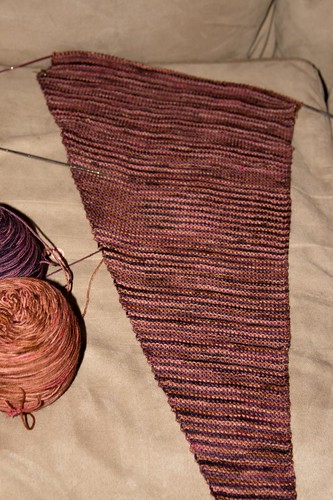
IMG_3490

It's on the right hand edge of the shawl. I'm sure you can, now that I've said something about it, but otherwise, you totally wouldn't know. (Lie to me people. I'm a woman on the edge.)

I think part of the reason I'm having issues with this shawl is that the colors I picked match a little too well. Though they are distinctly different when separate, there is pink in the purple and purple in the pink, and as you can see from the picture below, there are times when they stand out significantly, and times when they blur together. I've decided I like the effect, though, it looks kind of antiqued. Not as graphic as the people who are doing more solid, heavier contrasting colors, but I've always been a low-contrast kind of person (I present as evidence - just about every beaded item I've ever knit).
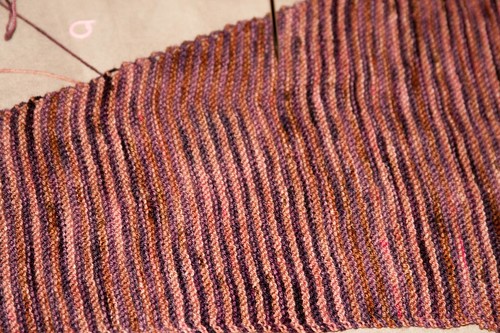
IMG_3486

It's very humbling to get my butt kicked by this simple little garter stitch shawl that I should be able to knit in my sleep. Fortunately, I now have this to remind me that I do not actually suck at knitting.
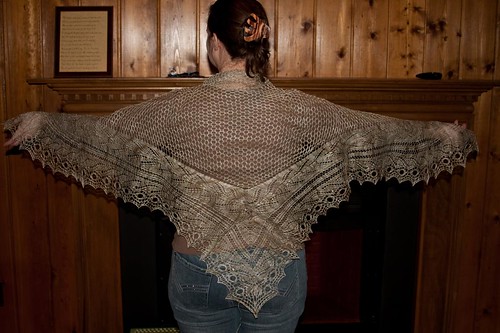
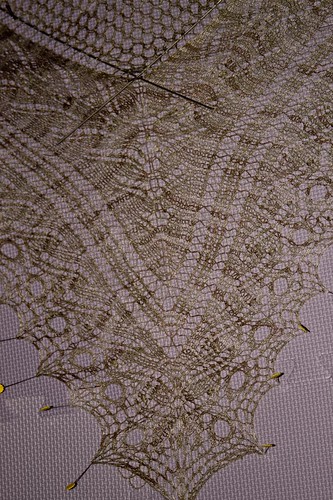
IMG_3497

IMG_3479

IMG_3478

IMG_3477

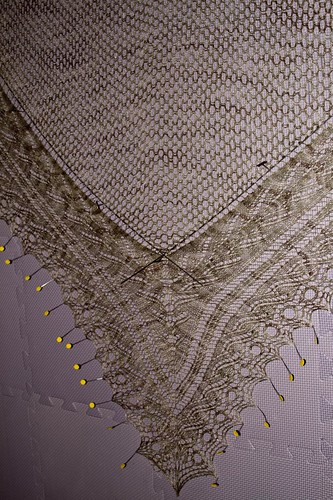
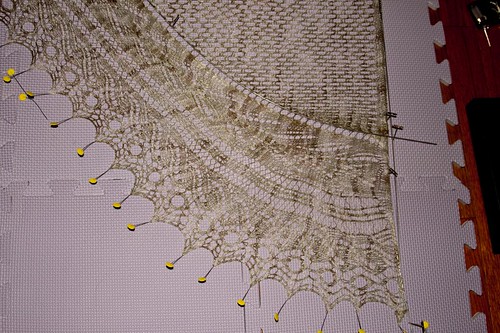
Pattern is, of course, Sevillano from Romi's pins and lace club - now available to the public for purchase!. Yarn is Schaefer Andrea in colorway Barbara McClintock. This was a match made in heaven - couldn't have been more perfect! I did two extra repeats of Chart D and had about 26 g of the yarn left over.
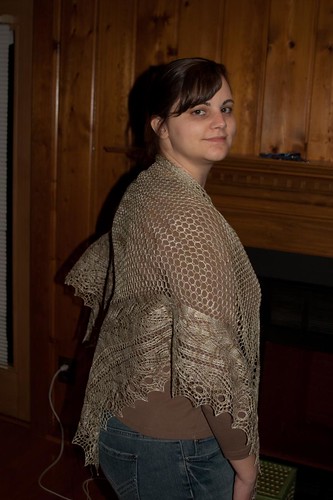
IMG_3495

Monday, November 22, 2010

Hard is a four-letter word

I love coming to the blog when I have been a good girl and taken pictures and dutifully prepared blog fodder. In fact, I promise a bonus blog entry this week, because I have so much to share that it seems criminal to cram it all in one post. I blog once a week because I work full time and so I can't get enough knitting done during the week to be worth talking about. But, this week and weekend were so crammed full of knitting and craft-related activities that I have lots to share. This has, unfortunately, resulted in a complete neglect of housework, laundry, and all things responsible.

The last installment of Romi's 2010 Pins and Lace club has been released into the wild, the lovely October design Sevillano (Rav link).

I love this design, I think it's gorgeous, I adore the flowing design motifs on the outside of the shawl, and the only thing holding me back from casting on right away was trying to figure out the right yarn. I went shopping last weekend and came up empty, and then when I was fretting about what to get (and the money I was probably going to spend), the SO asked, very reasonably, whether I didn't have anything in the stash I could use.

I was in the middle of impatiently telling him that OF COURSE I didn't have anything in the stash, when I stopped right in the middle of the sentence and shut my mouth, because I remembered this.

Knitting - 021

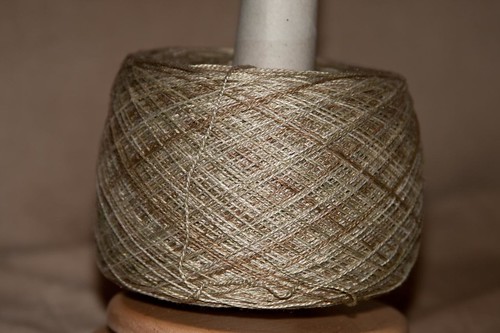
You may remember it from my inappropriate glee for having scored it at half price at the Knit Happens closing sale (let us have a moment of silence for a very worthy yarn store that has now passed on....aaand we're done). This is Shaefer Andrea 100% silk in colorway Barbara McClintock. Does the word 'perfect' come to mind or what?

So I did what any knitter would do.

Knitting - 107

Conscience pricked a little, so I finished Elektra before I actually cast on (more on that in the bonus post), but I didn't wait much longer than that.

Now, as a rule, I shy away from calling anything 'hard' because in my experience, people get intimidated when they hear something is 'hard' and quit before they even try. I have done dozens of supposedly hard things in my knitting career simply because I didn't know they were supposed to be hard. I think the worst thing anyone can do, especially a teacher (and although I am not a teacher, I find myself in that role fairly often in regards to knitting), is to tell someone else that something is hard.

And, frankly, it is very rare that I run something while knitting that is truly hard. The great thing about knitting is that it can be broken down into very tiny steps, and when you can do that something that seems to be hard is quickly downgraded to merely challenging. Such is the case with this pattern. It's challenging. This is not something you knit on the bus while chatting with your friends. It's something you knit at home, in good light, while awake and alert, so that you can break it down to the point where it becomes manageable. Taken one stitch at a time, it is very, very accomplishable.

With that said, I managed to screw it up several times. The good news is that this pattern is built from the point up, so that in the process of figuring out that this is not your average lace pattern, you only screw up a small number of stitches, so you can just rip it out and try again. Which is what I did. Twice.

Then I started giving the pattern its proper respect, got into the flow of things, and tooled along quite well. Then, as I was sitting on the couch being ignored by my boyfriend, who was deep in the throws of a Starcraft match, I realized that something didn't look right. I waited for his match to finish and made him pay attention to me for a minute while we put our heads together and figured out that I had, in fact, screwed up. To the great credit of his patience and knit-friendliness, he was the one who actually figured out what the problem was - or at least, where it was, which allowed me to figure out what it was.

Knitting - 108

The stitch markers in that photo mark the center stitch, and if you follow it down you will see that it ends in a yarn over. All seems well until you look at the unholy mess of string beneath the yarn over, which is what first alerted me that there was a problem. If you look at the arc of yarnovers to the left of that center stitch, you may be able to see there's a stray yarnover that's out of line. These two mistakes do not appear to be on the same row, but they are. Because of this shawl's ingenious construction, even though it's knit from the point up, it looks like a shawl that was knit from the center back. Because of this same construction, the rows tend to form themselves into arcs as you work, as you can see from the way the cable curves. So if you draw an arc from that stray yarnover to the mess below the center stitch, they are in fact in the same row.

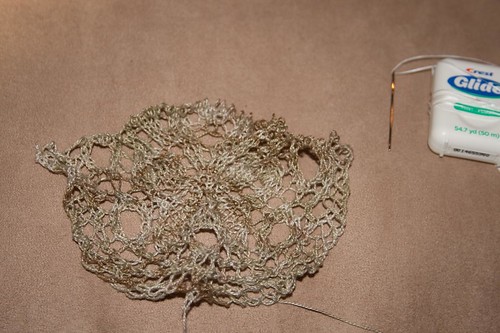
Now, I'm not afraid of a little laddering and lace surgery, but it was clear to me that this was going to be beyond my skill for that and I was going to have to rip out. And, naturally, in my arrogance (or laziness, you decide) I hadn't put in any lifelines - but I have a solution for this problem.

I put the shawl away for the evening and the next afternoon, rested, well-fed, and mentally sharp (or as close as I had a hope of getting), I assembled my tools.

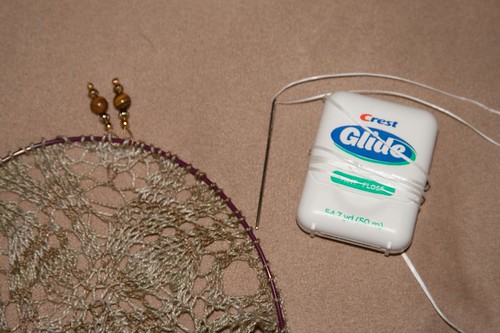
Knitting - 109

Mint optional. It just happens to be what I had.

Then I took a deep breath and took the shawl off the needles.

Knitting - 110

Scary. Then I carefully ripped back to what appeared to be the problem row, which, as it happened, was the row just above the row in which I purled my nupp stitches together. This made an easy reference point for when to stop.

Then I picked up my embroidery needle, threaded with dental floss, and took hold of the working yarn and pulled carefully, picking up each stitch on the embroidery needle as the working yarn slipped out of it. I couldn't take a picture of that part because my man was off pursuing his own hobby, Go, and was not around to assist me.

Knitting - 112

The sun was setting by now, and I was concentrating too hard to close the blinds, thus the dramatic lighting. Sorry about that. But it gives you the idea. I did find that because of the way the shawl tended to curve, it helped to occasionally pause and pull the needle up so that all the stitches were on the floss, allowing me to manipulate the angle of the needle a little more freely.

At last, I had all the stitches on the floss, or at least close to it. Sometimes when I do this the stitches drop a row despite my best efforts, and I end up with the row below it on my needle for a couple of stitches, but that is one reason I try to make the row I am picking up a purl row, because it makes those problems easier to fix. Sevillano does have some lace patterning even on wrong side rows, but it wasn't too bad and I was very careful, so I did good - I think I may have lost a yarnover or two but again, easily fixed.

Knitting - 113

Then I picked up my needles and followed the floss with the needle tip. If a stitch tried to dip, I pulled the floss taught and the stitches popped right back up where they belonged.

Knitting - 115

But Ninja, I hear you ask - why not just pick up the stitches with the needle in the first place.

Well, dear reader, that is a lesson I learned the hard way. The embroidery needle is so thin that it really doesn't put any stress on the stitches at all. I found that when I used the knitting needle to pick up the stitches, I inevitably jerked the loop of yarn out of the next stitch or two. Or five. The embroidery needle slides through neatly. I do recommend a slightly blunt needle so that you don't stab right through the stitch. The embroidery needle is shorter and more maneuverable than a knitting needle, and the dental floss doesn't pull or weigh down the project as you're working with it.

Once I had the needle completely through the project, I slid the whole thing to the cable and pulled the dental floss out (I find it's easier if the project is on the cable, so the floss has plenty of room to slide out).

Knitting - 116

I was then able to knit back up to where I was. If you compare the picture below with the first picture up top, you should be able to see the difference very easily. Now if you follow the center stitch down, it ends in that yarnover, but the stitches beneath it are tight and happy, not all stringy and loose and wonky.

Knitting - 117

Just to add insult to injury, as it turned out, the mistake was a dropped M1 stitch. My loathing of the M1 increase is well known, and I will sub it out any time I can, but in this pattern I thought it was best to do the increases as written. Clearly this M1 chose to take vengeance for all the vitriol I have uttered against its kind, and leaped off the needles while I wasn't looking. I didn't find the mistake because I did an extra yarnover in the same row, so I still had the right number of stitches when I worked the following row. One of the things I find challenging about this pattern is that I have been trained by all my lace knitting that decreases are paired with yarn overs, and in this pattern, there are several decreases who either have no yarn over or whose matching yarn overs take place further down the row. It's so ingrained in me that I should yarn over after a knit two together or before an ssk, that I do it without thinking. This has caused me problems before on patterns where the yarn over is on a side of the decrease that I didn't expect (for example, if the instruction is to ssk and then yarn over instead of the other way around).

Well. Problem solved, and I am moving onward with this beautiful (yet challenging) pattern. And let me encourage anyone reading this not to let the difficulty put you off from trying the pattern. If beauty were easy the world would be full of supermodels.

Most of the individual stitch techniques used in this shawl, such as nupps and twists, have been demonstrated on youtube, but I couldn't find a demo video for the triple yarn over stitch, so I made one, with the help of a trusty accomplice.


That's it for today - bonus post to come later this week!

ETA: Mercy, you guys, did I ever forget to spell check before posting. I promise I am not a complete moron, I just compose in Wordpad which doesn't highlight misspelled words, and I forgot to hit the spell check before I published the posts. I apologize for the crimes committed against the English language in the original version of this post. If you're reading this since this edit, you will be forever doomed to wonder what horrible mistakes I made, and I'm totally okay with that.